
Business Management -
Basics for Entrepreneurs.
Last modified June 2, 2026
Who benefits from this approach?
Entrepreneurs, business management analysts, planners, teachers, consultants and bankers can all benefit. This includes business journalists, future master craftsmen and high school graduates. Some may soon enter politics or be appointed to a company's supervisory board. Indeed, anyone involved in economics at schools, universities, training centres or in politics can reap the rewards.
Those who believe in 'standards' such as IFRS 18 are invited to reconsider their views on cash flow statement and income statement after reading this approach.
Simplifying for entrepreneurs' success
There is a long list of business management authors, particularly in English and French, who offer valuable advice to entrepreneurs and people setting up a new business. However, many fail to establish a connection with performance indicators.
There is a demand for early warning systems. In terms of liquidity, the base is always 'gross cash surplus' and the target is 'self-financing capacity'. The latter has to show the money generated independently which is available for investment after deposits and withdrawals and after repaying debts. However, there is much confusion to be resolved in between.
These writings contain a lot of criticism in order to make business management easier to teach and implement. Using the same terms in analysis and planning removes any barriers.
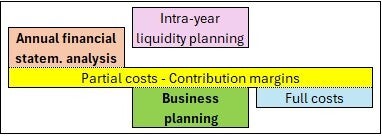
The time available for business management is limited. Entrepreneurs must focus on effective production methods, leadership of employees, environmental respect, pest and infection control, assurances, taxes, and their sector's public image. Additionally, entrepreneurs are facing increasing bureaucracy. In the future, there will probably be even less time available for business management. This is why entrepreneurs and supervisory boards are calling for meaningful business management terms.
Advantages of clear paths
The following pages provide an overview of the basics and a variety of indicators from an entrepreneurial perspective, along with several examples.
1. Profitability, liquidity and stability are at the heart of business management. Most importantly, if you introduce this core topic at the beginning, even newcomers who leave your course after the first few lessons will benefit.
2. The accountant's job is to produce reliable results. They must also deliver meaningful interim reports. Most importantly, it is the analyst's job to convert the annual accounting statement into an economic one.
3. Liquidity is the central daily target. Therefore, 'cash flow for self-financing of investments' (cash flow 3) should be used, with depreciation as a metric. Most importantly, the liquidity assessment is the same for micro family businesses as it is for large, internationally active groups.
4. In order to judge profitability, the remuneration of labour and capital activities must first be determined. Therefore, unpaid labour in a family company should be treated as paid work in order to calculate earnings per hour. Most importantly, dividing profit into 'three activities' according to IFRS 18 does not benefit entrepreneurs or supervisory boards.
5. Entrepreneurs should be informed of the costs and benefits of their business divisions as soon as possible. Most importantly: Even in existing companies, you can achieve sufficiently accurate variable and full costs using methods that business newcomers use. With a double-column schedule, you can calculate according to different classification systems simultaneously.
6. On business planning: Will you compare different target developments or use a year-on-year planning approach? The latter should be preferred if the company is experiencing financial difficulties. The same applies when new objectives have been set. Most importantly, it is helpful to choose a programme that allows you to switch between approaches. At least the loan lists are different.
7. If a company is experiencing significant financing difficulties, you need to calculate its short-term liabilities for the coming year. Most importantly, there is a helpful table that does not take up much time.
8. Digital computing replaced mental arithmetic in the 1960s. Previously, each column of numbers could only be handled using the same sign. Mental maths is why the concept of 'debit and credit' was invented — nothing else! Digital counting allows for different signs within a column of numbers. Most importantly, digititalisation made a very simplified theory of double-entry bookkeeping possible, eliminating the need for 'T-accounts' and the illogic of over-indebted companies.
It is preferable to have simple definitions that entrepreneurs, supervisory board members, and politicians can easily remember. They can learn more precise definitions later on if necessary.
For more details, see the file 'Business Management - Basics, Indicators, Examples.pdf. Please note that this file with about 80 pages is not a complete textbook. For example, it omits financial mathematics, machinery and building cost calculations, knowledge of market speculation and price cycle information. You can download this file here.