
Business Management -
Basics for Entrepreneurs
Last modified Septenber 12, 2026
Key words: Business, Company, Business Management, Business Analyses, Liquidity, Cash flows, Cash flow 1, Cash flow 2, Cashflow 3, Cash flow statement, BayWa, IFRS 18, Costs-Benefits, Contribution Margin, Business Planning, Liquidity Planning, Double-entry accounting, Debit/Credit
Why is this website interesting for you?
My aim is to make business numbers easier to understand, connect accounting with sustainable liquidity and help entrepreneurs, students and supervisory board members to recognise financial problems early, especially the danger of illiquidity. Many business management authors fail to link their guidance to performance indicators.
Using the same terms in business analysis and planning removes barriers and provides a unique perspective. For example, the following terms can be implemented in one software system. Contribution margins serve as a link.
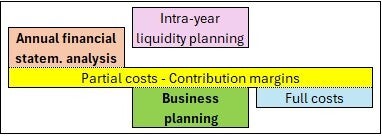
This website will display exceptional content. You can view a profit and loss model showing the accountant's Gross Cash Surplus. There is also a table for calculating the 'Ordinary Profit' figure. You may be interested to know that full costs can be traced by projections. If you are planning for businesses in financial difficulty, you will have to consider an additional cash flow term - in addition to the analytical cash flows 1-3. You will learn that users of the JUP PS programme can switch from target alternatives to year-on-year steps. When it comes to pedagogical or advisory work, it is really important to look for time-saving ideas.
The examples on this website often come from agriculture because that is where I worked as a teacher, adviser, and software developer. The logic is broader: every business must distinguish operating cash generation, owner-related flows, debt repayment, and reinvestment needs. The specific entries change from sector to sector; the entrepreneurial questions do not: Does the business generate cash, can it meet its obligations, and can it reinvest without undermining stability?
The two main focuses:
liquidity and digital double-entry accounting
Firstly, this website focuses on periodic liquidity. You will find a variety of cash flow terms created by business management experts. The concept of 'self-financing capacity' (capacité d'autofinancement in French) is recognised in several parts of the world. The favoured cascade cash flow 1-3 starts with operational cash flow and ends with self-financing capacity. The financial difficulties of the German BayWa Group are discussed. Question : Did their supervisory board receive the appropriate information? One section deals with IFRS 18.
Another focus of my website is the fundamentals of double-entry accounting in the digital age. The underlying account distinctions are based on general bookkeeping principles.
The bridge between accounting and cash flow
The Double-entry Table, introduced by the author in 1983, is based on four classes of accounts:
- Financial accounts (current accounts, receivables, loans and payables).
- Tangible asset accounts (such as buildings, machines, aquipements).
- Profit accounts (income and expenses)
- Private/non-company accounts, which include deposits and withdrawals.
In entrepreneurial analysis, these four classes lead directly to adjusted deposits and withdrawals and sustainable repayments, which are then converted into three cash flows and to benchmarks.
- Profit accounts → Gross cash surplus → Cash flow 1
- Private accounts → Adjusted deposits/withdrawals → Cash flow 2
- Financial accounts → Sustainable repayments → Cash flow 3
- Tangible asset accounts → Depreciation as benchmark of Cash flow 3
The following sources do not all present the same system. They are included here because they address related questions: self-financing capacity, cash-flow interpretation, IFRS 18, accounting education, and the role of debit and credit in a digital environment.
Global Voices on Cash flow & IFRS 18
- Agicap (France) — Self‑financing capacity determines investment ability.
- https://agicap.com/en-us/article/self-financing-capacity-definition-calculation/
- Anders (Germany) — IFRS 18 adds complexity without improving clarity.
- https://datenbank.nwb.de/Dokument/1043760/
- Beresford (USA) — Cash‑flow standard‑setting is a ‘balancing act’, not a science.
- https://www.sfu.ca/~poitras/cash-flow-stmt-history.pdf
- Finance‑Online (Germany) — Criticism of IFRS continues.
- https://www.finance-magazin.de/finanzabteilung/bilanzierung/kritik-an-ifrs-reisst-nicht-ab-29782/
- Hossain et al. (Bangladesh) — IFRS education faces structural barriers. https://www.researchgate.net/publication/361546751_Accounting_students_perceptions_of_ the_barriers_to_studying_IFRS_in_the_accounting_curriculum
- Partners Finances (France) — Free cash flow must be interpreted carefully.
- https://www.partners-finances.fr/actualites/474-free-cash-flow-flux-tresorerie-disponible-suivre-evolution-besoin-financement
- Sahay (USA) — Cash flow statements often fail to support real analysis.
- https://doi.org/10.1007/978-3-030-91231-4_72
- Keum (South Korean Capital Market Institute, 2025) – korean operating profit had "stronger value relevance, persistence, and predictive power for cash flows" than the one defined under IFRS 18.
- http://dx.doi.org/10.2139/ssrn.5443134
Global Voices on Digital Accounting
Theory researchers and practitioners worldwide question the necessity of teaching debit/credit and propose modern, digital approaches:
- Pincus (USA) — Debit/credit is not essential in introductory accounting.
- https://www.proquest.com/docview/210893454
- Rai & Sisneros (USA) — No pedagogical advantage from teaching debit/credit first.
- http://dx.doi.org/10.21511/afc.02(1).2018.02
- Warsono (Indonesia) — Revisits double‑entry from the accounting‑equation perspective. https://www.researchgate.net/publication/320912369_The_Accounting_Equation_and_Revisiting_the_Theory_of_Double-Entry_Bookkeeping
- Xavier (India) — Accounting without debit/credit is possible and teachable. https://www.flipkart.com/financial-accounting-analysis-without-debit-credit-revolutionary-innovation/p/itmefwq8ubgrkhzs
- Bookkeeping Studio (Australia) — Modern bookkeeping differs fundamentally from historical methods.
https://thebookkeepingstudio.com.au/bookkeeping/traditional-versus-modern-bookkeeping/
- Klever+ (USA) — Electronic calculation removed the burden of mental arithmetic.
https://www.linkedin.com/pulse/evolution-bookkeeping-from-old-school-ledgers-digital-marvels-ub9wf
- Maple Hill Services (UK/India) — Traditional bookkeeping is largely historical.
https://www.maplehillservices.com/post/is-traditional-bookkeeping-a-bygone-era-now
For more about accounting, download this file from my web-cloud :
'i Business Management – Basics, Indicators, Examples.pdf'
For comparison purposes, this file includes the debit/credit convention with « T-accounts » and « breakdown of the balance sheet ». Some German laws are also reflected there.